

Development Behind the Numbers: How New Uzbekistan Is Changing
In today’s globalized world, the authority of states is determined not only by their geography, natural resources, or military power, but also by the image formed about them — trust, transparency, and stability. International rankings and indices play an important role in shaping this image. They are like a mirror of the modern world: each country sees its reflection in it — sometimes bright, sometimes with flaws.
International rankings and indices have become an important tool for shaping public opinion about the political and legal development of states, the pace of reforms, and institutional capacity. One such source is the Rule of Law Index, prepared by the World Justice Project (WJP). This organization was established in 2006 at the initiative of the American Bar Association and has operated as an independent entity since 2009. The 2025 Index covers 143 countries and territories and is based on 8 factors, 44 sub-factors, the opinions of more than 215,000 respondents, and over 4,100 experts.
Thus, it is not just a statistical table — it is a serious analytical document.
According to the WJP 2025 report, Uzbekistan ranked 81st out of 143 countries, and 8th out of 15 countries in its region. Notably, against the backdrop of declining rule of law indicators in 68 percent of countries worldwide, Uzbekistan is among the few states showing improvement.
The report also highlights the following indicators:
- “Order and Security” — 17th place, 1st in the region
- “Absence of Corruption” — 67th place
- Civil Justice — 73rd place
- Criminal Justice — 68th place
Moreover, while many countries are experiencing increasing pressure on judicial independence, such trends are not observed in Uzbekistan, which is specifically emphasized in the report.
However, an important question arises here: it is not only about “what place a country occupies.” The main question is — what real changes stand behind these results?
After all, any index is just one perspective, one methodology. Even the WJP itself acknowledges that the index does not reflect the full picture, but only certain aspects. Therefore, such rankings are better perceived not as a final verdict, but as an important signal.
This approach also aligns with the UN 2030 Agenda, which emphasizes that when implementing common goals, it is necessary to take into account national conditions, capacities, and levels of development.
Indeed, concepts such as openness of government, civic participation, or freedom of speech manifest differently across societies. While in the West these are often expressed through NGOs and mass movements, in Uzbekistan they are reflected through the mahalla, family, and collective forms of discussion.
International experience also shows that a high ranking does not mean the absence of problems. For example, the European Commission’s 2025 report notes the presence of unresolved issues alongside positive changes.
In France, in 2023, the prison overcrowding rate reached 122.9, while in Italy it was 119.1. In the United Kingdom, as of December 2025, there were 80,203 pending cases in courts. This indicates the existence of systemic problems even in developed countries.
In the United States, in 2024, one violent crime was committed every 25.9 seconds. These figures show that a high ranking does not always guarantee a high level of safety.
From this perspective, one of Uzbekistan’s key advantages is precisely security. In the WJP report, the country ranks 17th in “Order and Security” and 1st in the region. This is not just a number — it is an indicator of stability and calm in everyday life.
Another important aspect is the real results of reforms. As of April 1, 2026, there are 577.2 thousand enterprises operating in Uzbekistan, of which 421,969 are business entities, and 417,250 are small businesses. The number of enterprises with foreign investment has reached 19,072.
These figures demonstrate that reforms are working not only on paper, but in real life.
In terms of civic participation, Uzbekistan has also chosen its own path. According to the UN analysis for 2025, more than 9,000 mahallas operate in the country. The “mahalla seven” system contributes to strengthening collective governance and social cohesion.
Another important achievement is that in 2022, the International Labour Organization (ILO) officially recognized the elimination of forced labor in Uzbekistan’s cotton sector. During the 2021 harvest, 99 percent of participants worked voluntarily.
The legal framework is also being strengthened. The updated Constitution of Uzbekistan enshrines the direct applicability of human rights. This is an important step toward building a rule-of-law state.
Of course, challenges remain. The WJP report notes lower scores in openness and fundamental rights. However, it also recognizes the absence of negative trends in judicial independence.
In conclusion, it can be said that today every country is searching for its own path. New Uzbekistan stands out as a model striving to find a balance between tradition and modernization, stability and freedom.
This experience is not perfect, but it is important. And most importantly — it works.
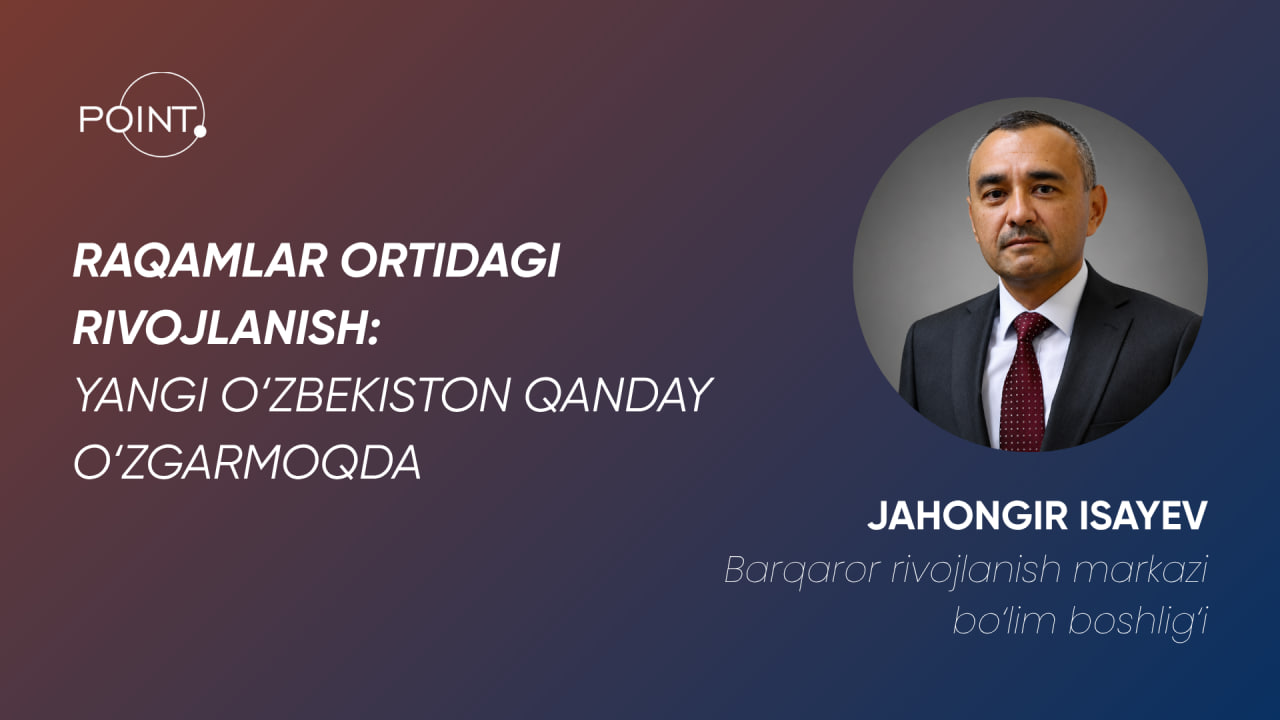
Jahongir Isayev
Head of Department, Center for Sustainable Development