

Analytical Report based on Research Findings on Attitudes Toward Wedding Expenses in Uzbekistan

From June 19 to July 3, 2025, the “Yuksalish” Movement conducted a nationwide survey titled “Weddings in Uzbekistan,” aimed at exploring public attitudes toward wedding traditions, associated expenses, and their impact on household budgets.
The objective of the survey was to identify key trends, determine the main driving factors behind high wedding expenditures, assess public sentiment regarding prevailing traditions, and develop practical policy recommendations.
Research Methodology
The analysis is based on tabulated survey data containing respondents’ answers across the following key thematic blocks:
Geographic and Demographic Data: region, district, marital status.
Financial Situation: average monthly household income.
Wedding Practices: whether a wedding has been held or is being planned, estimated cost, sources of funding.
Value Orientations: attitudes toward the necessity of large expenditures, perceived reasons for high costs.
Ideals and Preferences: preferred wedding format, alternative ways to allocate funds, attitudes toward lavish celebrations.
Readiness for Change: support for specific changes in wedding traditions.
This report constitutes a popular-scientific public opinion study conducted to identify general trends and societal attitudes. Given its applied and informational nature, statistical margin of error calculations and confidence level estimations—typically required in rigorous academic research—were not conducted.
The survey was conducted online via social media platforms and partner networks.
The collected data were systematized and analyzed. This report presents an analysis and interpretation of the survey results.
A total of 1,247 respondents participated in the survey. Among them:
Ages 18–30: 34.3% of respondents
Ages 30–45: 35.5% of respondents
Over 50 years old: 30.2% of respondents
Among them:
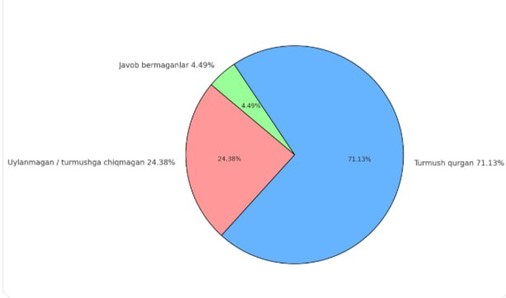
Married – 71.13%
Unmarried – 24.38%
No response – 4.49%
The majority of respondents are married, highlighting their direct engagement with the topic of wedding traditions and related expenses.
The study covered respondents from various regions of the country, including the capital, regional centers, and districts. Citizens from all parts of the country participated in the survey:

The data analysis enabled several key conclusions to be drawn, reflecting the complex socio-economic and cultural context surrounding wedding celebrations in Uzbekistan.
In response to the question, “In recent years, have you had a wedding in your family or are you planning to hold one?” the majority of respondents indicated that they either have held or are planning to hold a wedding.

- Financial Burden and Income Disparity
There is a clear gap between the income levels of most families and their actual or planned wedding expenditures.
The distribution of respondents’ average monthly household income is as follows:

Income: A significant share of respondents—81.24% (particularly in the regions)—reported a monthly household income ranging from 5 to 12 million UZS.
In response to the question, “Approximately how much did you spend (or plan to spend)?” respondents provided the following answers:

Up to 30 million UZS – 31.28%
Up to 50 million UZS – 23.98%
Up to 70 million UZS – 15.72%
Up to 100 million UZS – 15.88%
Over 100 million UZS – 9.62%
Expenditures: Planned or actual wedding expenses often amount to between 50 and 100 million UZS or more for 65.2% of all respondents. This is equivalent to, or in some cases exceeds, a family’s annual income.
Sources of Funding: As a result, the overwhelming majority of respondents do not cover wedding expenses through personal savings. The main sources of funding are:

- "Self-funded with support from family" – 55.17% of respondents. This response highlights the collective nature of wedding financing, where the financial burden falls not only on the couple but also on their parents and extended family.
- "I took/plan to take a loan" – 25.1%. This indicates a high level of indebtedness among the population due to wedding expenses.
- "My income is sufficient" – 14.11% of respondents.
- No response – 5.62%.
This suggests that weddings represent a significant financial burden that does not align with the current income levels of many families, often pushing them into debt and creating risks to the financial stability of newlyweds at the very outset of their married life — or to that of their parents.
2. Key Driver of Expenses — Social and Parental Pressure
In response to the question about the reasons behind high wedding expenses, respondents could select multiple answers. Most frequently, they pointed to external factors rather than personal preferences.

- “Social pressure / the obligation to present oneself publicly” was cited by 46.11% of respondents.
This is the dominant reason, reflecting a deeply rooted cultural perception of weddings as public events whose status is judged by society. The fear of ‘uyat’ (shame) and the desire to “save face” compel families to spend beyond their means.
- “Desires and dreams of the couple” – cited by 31.36% of respondents.
- “Desires and dreams of the parents” – the second most significant factor, selected by 29.03%. In many cases, it is the older generation that insists on a lavish celebration, viewing it as a fulfillment of personal ambitions and a social obligation toward relatives and the community.
- “Expectations from the in-laws” – this factor also plays a substantial role, creating a competitive dynamic between the two families, according to 16.6% of respondents.
Thus, high wedding expenditures are less a matter of personal choice by the couple and more a result of intense social pressure and expectations from the older generation and society at large.
In response to the question, “Do you believe that social surroundings exert pressure on families to hold expensive weddings?” respondents’ answers reveal a division of opinion within society, with a slight majority acknowledging the existence of such pressure.

“No, it is a private matter for each family” – 34% of respondents
“Yes, absolutely” – 30.05%
“More yes than no” – 19.95%
“More no than yes” – 11.54%
No response – 3.76%
Although the largest group views wedding expenses as a matter of personal choice, half of the respondents directly or indirectly acknowledge that social pressure compels families to organize costly celebrations. This indicates an internal societal conflict: on one hand, there is a desire for autonomy in decision-making; on the other, there is the powerful influence of entrenched traditions and social expectations. The findings underscore that perceptions of pressure are not uniform, yet the issue remains relevant for a significant portion of the population.
3. Gap Between Ideal and Reality: A Desire for Simplicity vs. the Practice of Excess
Survey data reveal a significant internal contradiction within society.
- Ideal Format: In response to the question “What should a wedding be like?”, the majority of respondents (39.62%) selected options such as “modest” or “moderate, in the circle of close family and friends.” The option “lavish and extravagant” was chosen considerably less frequently—only 6.66% of respondents.

Attitude Toward Lavish Weddings: Many respondents agree that lavish weddings are “a source of unnecessary stress and debt”

and express regret over the money spent—44.51% of all respondents.

This indicates a clear societal awareness of the irrationality of lavish weddings and a strong desire to hold more modest celebrations. However, this rational perspective is unable to overcome the barrier of social norms and traditions. People find themselves trapped: they do not want to spend excessively, yet feel compelled to do so.
- Preferred Alternatives: Given the choice, respondents would prefer to allocate funds toward education, housing, travel, health recovery, or investments in business.

The survey revealed that, instead of lavish weddings, residents of Uzbekistan are willing to invest in their future—through education, home ownership, health, or business development. This reflects a growing commitment to financial literacy and long-term planning.
4. Readiness for Reform and Concrete Proposals
Respondents demonstrate a high level of readiness for concrete changes aimed at optimizing wedding traditions.
In response to the question, “In your opinion, how can attitudes toward wedding expenses be changed in your region?”, the majority pointed to the need for administrative measures, public awareness campaigns, and improved financial literacy among the population.
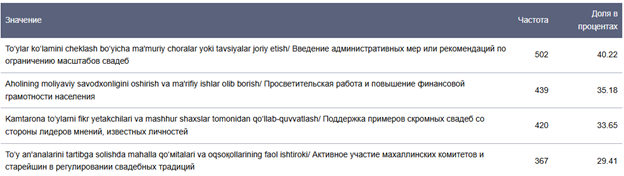
The following changes received the highest levels of support:
- “Reducing the number of guests and the overall scale of the ceremony” – proposed by 35.69% of respondents
- “Reducing certain post-wedding events” – noted by 31.44% of respondents
- “Reducing certain pre-wedding events” – supported by 37.61% of respondents
The least supported option was “No changes are necessary,” selected by only 7.14% of respondents.
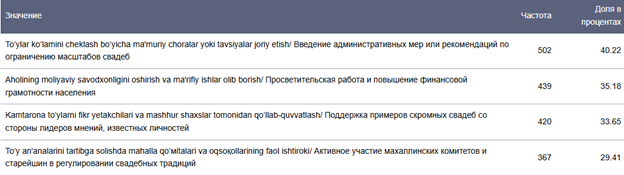
Conclusion: There is a clear public demand for the reform and simplification of wedding traditions. People are willing to forgo the most costly and exhausting elements of the celebrations.
General Conclusions of the Survey
- Modern wedding expenditures in Uzbekistan are a leading cause of household debt, negatively affecting families’ starting opportunities.
- The main driver of such excessive spending is not personal desire, but rather intense social pressure, the cultural norm of public display, and expectations from the older generation.
- A clear societal conflict exists between the rational understanding of the harm caused by overspending and the irrational adherence to tradition driven by fear of social judgment.
- The majority of the population is ready to simplify wedding rituals and supports the idea of reducing the scale of celebrations and related events.
Recommendations:
Based on the findings, the following comprehensive recommendations are proposed to help shift public attitudes toward wedding expenditures:
1. At the State and Community Level:
Information and Awareness Campaign:
- Launch a nationwide media campaign (TV, internet, social media) under targeted slogans, emphasizing financial literacy and the psychological stress associated with extravagant celebrations.
- Actively involve popular actors, singers, bloggers, athletes, and religious leaders to promote the concept of modest weddings. Their personal example and public statements can significantly influence societal attitudes.
- Grant mahalla committees and community elders the authority to conduct outreach with families planning weddings and to encourage modest celebrations through public recognition and support.
- Enhance monitoring of existing legal recommendations limiting the number of guests and the duration of events. In cooperation with municipal authorities (hokimiyats), develop advisory norms to guide the scale and scope of wedding celebrations.
2. For Educational Institutions and Financial Organizations:
- Introduce mandatory special courses in schools and universities on the basics of household budgeting, financial planning, and the risks of consumer lending.
- Develop and promote targeted savings accounts for young families (e.g., “For Housing,” “For Education”) as alternatives to wedding-related loans.
3. For Families and Newlyweds:
- Encourage open intergenerational dialogue between parents and children about goals and priorities. Couples should feel empowered to express their desire to allocate resources toward more meaningful objectives (such as housing or business), while parents should be willing to listen and support these choices.
- Shift the focus from weddings as a “performance for others” to their true purpose — the formation of a new family. The celebration should be for the couple themselves, not for hundreds of distant acquaintances.
Addressing the issue of excessive wedding expenses requires a comprehensive and systemic approach that combines education, public discouragement of extravagance, and the promotion of financially responsible behavior.