

Youth Potential and Hiring Challenges: Employers' Opinions
The development of human capital is a key factor in the successful economic growth and social well-being of a country. This concept includes not only the level of education and professional skills but also the quality of health, motivation, innovative thinking, and the ability to adapt to changing conditions.
Uzbekistan is undertaking large-scale measures to develop the labor market and ensure employment for the population. In 2024, it was planned to create conditions for the employment of five million people, including within investment projects and industrial development. Moreover, special attention has been given to the development of entrepreneurship.
A new system aimed at ensuring youth employment and addressing their challenges—the "Youth Notebook"—has been introduced. Additionally, "Ishga Marhamat" mono-centers, vocational training centers, and short-term courses have been launched nationwide. One of the strategic goals announced by the President is to reduce the poverty rate from 11% to 7% within the next three years, and the measures being taken could contribute to this objective.
A comprehensive approach to job creation, entrepreneurship support, and economic modernization forms a solid foundation for the country's sustainable development, contributing to the well-being of citizens and strengthening economic stability.
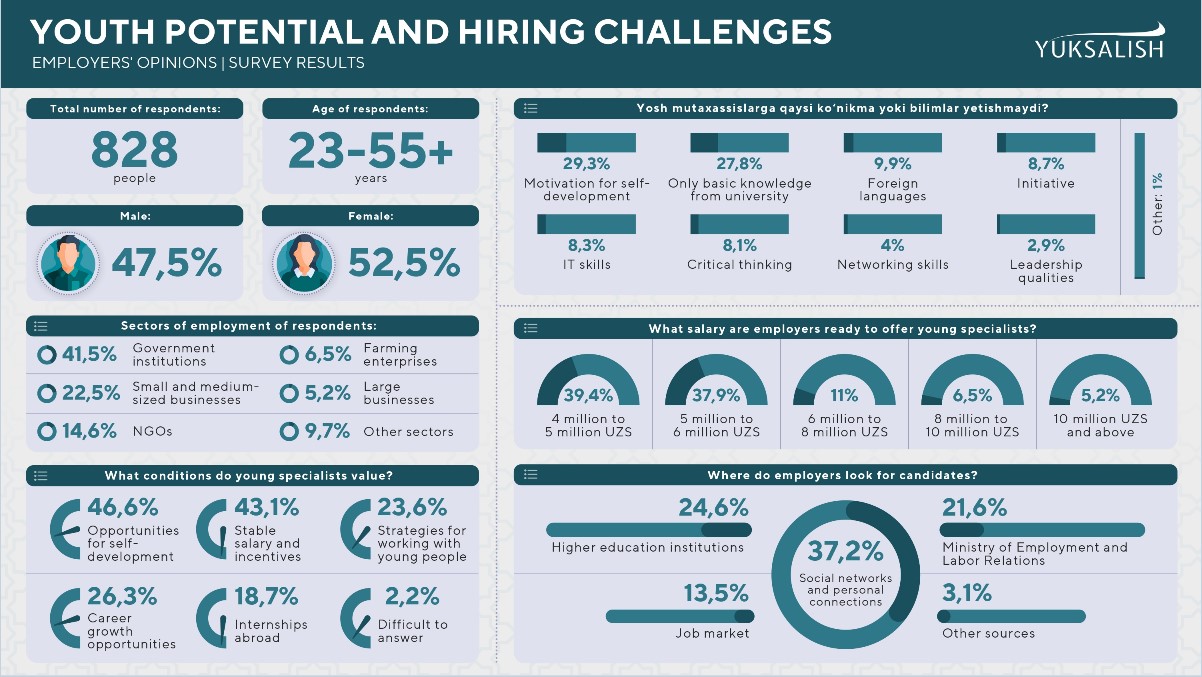
The "Yuksalish" movement conducted a survey among employers to understand their opinions on hiring young professionals. Responses were collected using the Google Forms platform. The survey was organized among representatives of small and medium-sized businesses, heads of government agencies, farming enterprises, and NGO leaders. A total of 828 individuals aged 23 to 55+ participated. The number of respondents was proportionally distributed across different regions of Uzbekistan.
Respondents represented various age groups, allowing for a diverse perspective on interactions with young professionals. The majority—67%—were aged 25 to 45. A significant number of older participants (45-55 years—24.6% and 55+—8.4%) also reflected broad involvement and experience in working with young specialists.
Among respondents, 47.5% were men and 52.5% were women. The survey covered all regions of Uzbekistan.
Sectors of Employment
A total of 41.5% of respondents work in government institutions, highlighting the public sector's role as a source of workforce initiatives. Small and medium-sized businesses also constitute a significant portion—22.5%, while 5.2% represent large businesses, indicating the importance of young specialists for growth and innovation in the private sector. Additionally, 14.6% of respondents were from NGOs, 6.5% from farming enterprises, and 9.7% from other sectors, all of whom emphasized the need for flexibility and new approaches in hiring young professionals.
Employers' Concerns
Almost one-third — 27.8% — of employers pointed to an insufficient level of basic knowledge among university graduates, suggesting the importance of revising educational programs with a greater emphasis on practical experience.
Another major issue is low motivation for self-development—29.3% of surveyed employers selected this concern. Specifically, 8.7% noted that young employees do not strive for self-improvement, 8.1% stated they lack systematic and critical thinking skills, 4% identified poor communication skills, and 2.9% mentioned a lack of leadership qualities.
Additionally, 8.3% of respondents observed that some young professionals lack proficiency in information technology. Furthermore, 9.9% reported inadequate foreign language skills, which, in the context of digitalization and globalization, are becoming essential. The remaining 1% identified other shortcomings.
Salary Expectations for Young Professionals
Most employers are willing to offer young professionals salaries ranging from four to six million UZS. This reflects the wage level for employees with minimal experience. The majority — 39.4% — consider 4-5 million UZS an optimal starting salary. Slightly fewer — 37.9% — are willing to pay 5-6 million UZS. About 11% intend to offer 6-8 million UZS, while only 6.5% are prepared to pay 7-10 million UZS. High-paying positions remain rare — only 5.2% of employers are willing to pay 10 million UZS or more, limiting young professionals' opportunities for competitive compensation at the start of their careers.
Key Factors for Improvement
Employers highlighted several key directions for developing a skilled workforce:
-
46.6% prioritized creating conditions for self-development;
-
43.1% emphasized the importance of stable wages and incentive systems, such as bonuses and grants, as tools for retaining young professionals and encouraging their growth;
-
26.3% noted the significance of career growth opportunities;
-
18.7% highlighted the importance of organizing internships abroad;
-
23.6% stressed the need for structured strategies to work with young professionals;
-
2.2% were unsure of their response.
The primary sources for recruiting young professionals remain online platforms, personal contacts, and job sites—37.2% of respondents emphasized the growing role of digital technologies in hiring. Additionally, 24.6% recruit from universities, 21.6% through the Ministry of Employment and Labor Relations, 13.5% via job centers, and 3.1% selected "other" methods.
Recommendations Based on Survey Analysis
-
There is a need to review and adapt educational programs with a focus on practical skills and the application of theory in real-world scenarios. Internship and apprenticeship programs should be developed to help students gain real work experience before graduation.
-
Employers can implement internal training programs and encourage participation in external courses and workshops, including access to online learning platforms.
-
Competitive employment conditions, including social and medical benefits, can enhance employers' attractiveness.
-
Strong collaboration between employers and universities is essential to align student preparation with labor market demands. This can include partnership agreements, joint programs, and employer participation in the educational process.
-
Creating a positive corporate culture where young professionals feel valued and heard is crucial.
These recommendations will help employers in Uzbekistan effectively utilize the potential of young professionals, preparing them for the challenges of the modern labor market.
The employer survey identified both advantages and challenges in working with young professionals. The key problems include a lack of basic knowledge and low motivation for self-development. However, employers are willing to offer competitive working conditions, focusing on stable wages and career growth. The importance of digital platforms and educational institutions in the hiring process is also noteworthy. To further improve the situation, investments in education reform and support programs for young specialists are necessary to bridge the gap between university training and labor market demands.
Press Service of the "Yuksalish" Movement