

Public discussion:
What is the reaction of our citizens to the events happening in and around our country today? Is there a single approach to understanding our national interests in various fields, or are there enough sources of information that serve to form this approach and explain it to society?
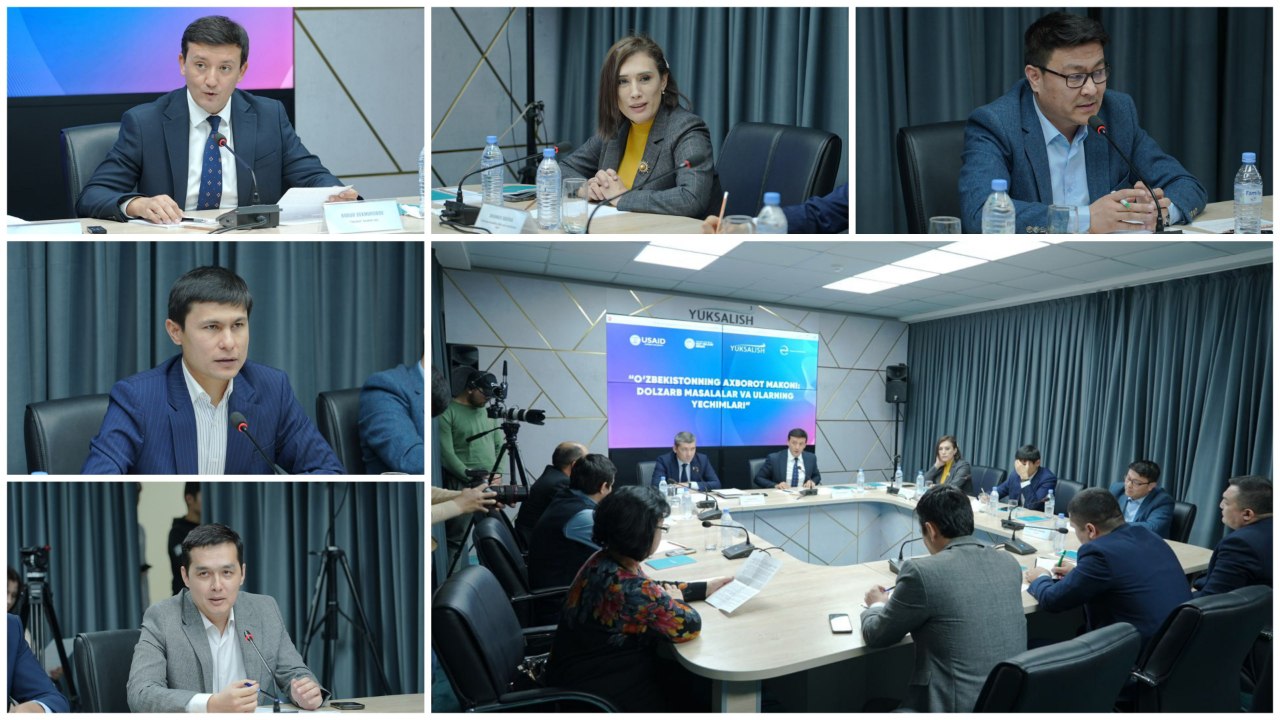
On January 30 of this year, the "Yuksalish" movement held a public discussion on the topic "Information space of Uzbekistan: current issues and their solutions". Relevant state agencies and organizations, civil society, media representatives, and national and foreign experts participated in the public discussion.
A number of positive steps have been taken to ensure freedom of speech and media activity in Uzbekistan. If we look at the national media landscape today, we can see that the number of registered media has increased by 41 percent in the last 7-8 years. In 2016 1,514 mass media were registered, while in 2023 their number exceeded 2,100, 65% of which are non-governmental mass media.
The number of registered TV channels increased from 65 to 84 (+29%), internet publications increased from 395 to 745 (+88%), and the number of newspapers decreased from 691 to 631 (-9%).
These figures, in a certain sense, indicate that journalists and bloggers have become more active in promoting reforms, human rights, and social interests in our country, conveying them to the people, and expressing an active citizenship position.
— The state created certain conditions for national content. This can be seen in tax benefits, relief in media registration. Currently, the Information Code is being developed and reviewed together with the international community. A special draft law on non-interference in journalistic activity has also been prepared, says Marat Aitov, Head of Information and Mass Communications Agency.
Despite this, it was noted that the state of national content in the information space of the country is not satisfactory, especially in terms of national interests in various social, economic and political issues and there is a lack of quality content.
It was noted that a number of external "information attacks" have recently caused concern to the public of Uzbekistan, and among such attacks there are cases where the sovereignty of our country and the history of our statehood are called into question.
President Shavkat Mirziyoyev responded to this issue at an extended meeting of the Security Council on January 12: "As long as we do not take into our own hands the creation of national content in the information space of Uzbekistan, and we do not assess world events from the point of view of our national interests, these things be made from abroad. Because if we do not fill people's need for news, analytical information, and real events, others will do that. This is absolutely unacceptable," he said.
Also, the discussion focused on the problems of developing national content, for example, the fact that the gaps are being copied from foreign countries due to a lack of funds or personnel to create resources on national topics. As our national information space is filled with foreign information, this situation causes the national content to stop developing. It is necessary to cover information not only on our own, but also on foreign resources, inform the world, and strengthen analytical journalism.
Shahnoza Soatova, adviser to the Minister of Justice, blogger:
- One of the problems is that there are few national content creators, that is, producers and distributors of information. The issue of level is also lame. It's difficult to create quality, fast-spreading content even with the perfect technical support. It is true that there is a lack of creative industry and personnel. Journalists, still face problems of ethics, professionalism, socialization, and unity for an idea. I think that it is necessary to be able to set the general idea and goals correctly.
Khushnud Khudoyberdiyev, First Deputy General Director of the National Information Agency of Uzbekistan:
— To what extent are we able to respond to external information attacks? Especially when there are attacks on serious and political issues, everyone can express their opinion, but everyone still expects an official response from the state. When the authorities come out and express their opinion, internal fear (censorship) is suppressed in the society, and it continues by itself saying "it is okay to talk about this topic". We are in this system now whether we like it or not. Maybe over the years it will disappear. As we try to adapt to the times, the authorities need to speak more. This is also one of the ways to develop content. In general, there is a lot of content and different topics. Only the following audience is different. We have gaps in some topics, in some topics the consumer is enough.
Kamoliddin Robbimov, political scientist:
— There should be the ability to listen to the social problems collected from the community, properly qualify and propose the right solution. This requires a great deal of political skill. Today, Uzbekistan is trying to be neutral and pursue a multi-vector foreign policy. Why did the president link security with information sovereignty in his speech? The reason is simple - behind any military action today is an intense information war. In order for us to fully achieve freedom of speech, it is necessary to increase the abilities of the state itself, its institutions, to work with society, to listen to society and to find solutions. Another regrettable issue is that national content is not satisfactory on TV channels covering 90 percent of the population of Uzbekistan. There is no argument that the level of formation of social thinking and integration of society and the state in TV channels is very low.
Muhrim Azamkhojayev, Deputy Editor-in-Chief of Gazeta.uz:
- In fact, state television can easily "signal" to "informational attacks" from outside. There are state publications, but we do not find articles with negative content, let alone sharp, critical materials. There should be creative freedom. It is important to nationalize some popular applications and fill them with national information.
The participants of the discussion made suggestions and recommendations regarding the appropriate response to the increasing "information attacks", ensuring information sovereignty and increasing the flow of quality information:
- There should also be quality content for consumers. Today's society, in some ways, remains a consumer of useless content, and here the issue of raising a generation that accepts quality content is also considered important;
- Programs covering foreign political topics should be supported through special grants. Such projects are few, and those that exist are seen by very few people, and as a result, such projects are not continued due to lack of financial benefit;
- Some of the big channels are, in a sense, setting the weather for today's news space. But the information they spread is not of good quality, needs fact-checking and sometimes lies. It is necessary to think about issues of training and increasing the capacity of the operators of such channels. Most of them operate anonymously. This lack of responsibility can lead to violations;
- It is necessary not only to react to "information attacks", but also to take practical actions and show collective courage. Public restrictions (ban-list) can be added to the attacked sources or declared as "unwanted person" (non grata).
We remind you that the discussion was organized with the support of the Eurasia Foundation within the framework of the "Social Innovations in Central Asia" program funded by the US Agency for International Development (USAID).
Press Service of "Yuksalish" Movement